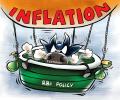
Inflation breached the upper end of the RBI's comfort level of 4 per cent plus-minus two percentage points.

Real estate developers and consultants on Tuesday said RBI's decision to hike policy rates by 25 basis points will affect the sentiment of the property market, but they do not foresee any major impact on housing demand and prices.

They sought further cut in interest rates as well as reforms.

The Reserve Bank of India has increased the repo rate under the liquidity adjustment facility (LAF) by 25 basis points from 8.0 per cent to 8.25 per cent with immediate effect.
The Reserve Bank of India (RBI) may not go in for key policy rate cuts in its quarterly policy review slated for January 23, said a senior finance ministry official.
Reserve Bank Deputy Governor S S Mundra on Friday said that he expects banks to cut interest rates
The Reserve Bank of India in its quarterly monetary policy review has hiked rates.

The Reserve Bank of India (RBI) conducted two overnight variable rate reverse repo (VRRR) auctions on Tuesday, marking the first instance of such action in a single day. The move aimed to reduce liquidity from the banking system, which has been largely in deficit mode for the past four months. Market participants noted that the central bank held the second VRRR auction due to its awareness of funds being released to banks during the day.
The repo rate has been unchanged since January, when the RBI increased it by a quarter percentage point.
Public sector banks have already begun slashing their prime lending rates while some in the private sector space have so far refrained from doing so. "Private sector banks will (now) have to reduce their rates," Prime Minister's Economic Advisory panel chief Suresh Tendulkar said. "Banks are well-capitalised but the current problem is that they are unwilling to lend."

Shaktikanta Das will demit the office on Tuesday after completing six years as the 25th Governor of the Reserve Bank of India. Revenue Secretary Sanjay Malhotra will replace him as the 26th Governor. He was appointed as the Governor on December 12, 2018, after the abrupt exit of Urjit Patel.

Monetary Policy Committee keeps key interest rate (repo) unchanged at 4% for 7th consecutive time; Consequently, reverse repo rate too remains unchanged at 3.35%; Bank rate also remains same at 4.25%;

Weakness in the rupee against the US dollar also weighed on domestic stocks. The local unit fell 11 paise to 70.60 against the US dollar intra-day.
India's booming real estate sector might feel the pinch after RBI's decision to hike short-term interest rates, as a possible shift in bank lending away from the sector as well as an imminent hike in home loan rates could spoil the realty party.

The RBI's next policy review is set for Sept. 29.

'Even if there is a third wave or a fourth wave, it is hard to see the economy will suffer like that (during the first wave).'

Fundraising through qualified institutional placement (QIP) has revived this year, led by commercial banks, after a lacklustre 2022. According to data compiled by Prime Database, Indian companies have raised Rs 53,070 crore in 2023 so far, of which seven banks - Union Bank of India, Indian Bank, Bank of India, Federal Bank, IDFC First Bank, Bank of Maharashtra, and J&K Bank - account for Rs 21,290 crore, or about 40 per cent. If other financial institutions are included, the figure surges to Rs 26,690 crore.

The Reserve Bank of India unexpectedly raised its policy interest rate on Tuesday by 25 basis points (bps) but said that if consumer price inflation eases as projected, it does not foresee further near-term tightening.

The lender, however, is not likely to reduce its base rate to which all loan rates are linked.
Part of a focus on retail advances, as corporate demand remains subdued; could reverse if RBI raises repo next month

As per SIAM data, the total sales of vehicles across categories registered a decline of 5.45 per cent at 14,51,278 units in February 2013 as against 15,34,910 units in the same month of 2012.
The Reserve Bank of India (RBI) unexpectedly kept the country's policy interest rate on hold on Wednesday, despite calling current inflation too high, citing the prospect of easing retail prices and its concerns about the weak domestic economy.

RBI on Tuesday raised the repo rate, at which banks borrow from the central bank, by 50 basis points to 7.25 per cent, thereby making funds costlier for banks.
CRR to remain unchanged at 4.00 pc this fiscal
RBI recently hiked the repo and reverse repo rates by 25 basis points to check the spiraling inflation in the country. Any further rate hike is also expected as the RBI has hinted to do so in order to suck excess liquidity from the market.

As it stands, there does not seem to be a threat to prices.
The Reserve Bank may go for a final 25 basis points increase in the current rate hike cycle next week and a reduction would come in only by the end of third quarter of FY24, economists at Axis Bank said on Wednesday. As per media reports, RBI officials met economists on Tuesday, and the latter have suggested the central bank to go for a 25 basis points hike in key rates. Since May 2022, the RBI has hiked rates by 250 basis points, hurting borrowers and some are already concerned about loan tenors extending beyond their working lives as a result of the hikes.

The Governor said the MPC had voted to maintain its accommodative stance, implying more rate cuts in the future if the need arises.
Mirroring weak cues from the overseas markets, the Sensex opened with a negative gap of 215 points at 10,765. The index thereafter tried to recover but slipped to lower levels after the Reserve Bank of India (RBI) announced its annual credit policy.
Bankers and other stakeholders are now almost certain that the Reserve Bank of India (RBI) will increase the key policy rate, or the repo rate, by 25 basis points (bps) on Tuesday.

Real estate companies' borrowing costs have moved up by a third in the last one and a half years, from 11.5-12 per cent to 16 per cent now.

RBI has announced a 50 bpc rate cut, India Inc cheers the move.

The Indian currency resumed lower at 61.50 per dollar as against the last closing level of 61.46 at the Interbank Foreign Exchange Market.
RBI slashes repo and reverse repo rates to all-time lows.

At present, the repo rate acts as the policy rate when liquidity is in deficit mode while reverse repo becomes the operating rate when there liquidity is surplus.
The transmission of the last cash reserve ratio cut has also not happened fully because that came in March.
The Reserve Bank of India is unlikely to change the policy rates the repo and reverse repo rates in its mid-term review of the monetary policy amid persistent inflationary expectations following copious foreign capital inflows. Headline inflation has dropped significantly below RBI's target of 5 per cent for 2007-08 but this is a result of the government deciding not to pass on the increase in oil prices to consumers.
Growth remains weak, inflation is within 2-6% range, rate cut would help recoup forex reserves
